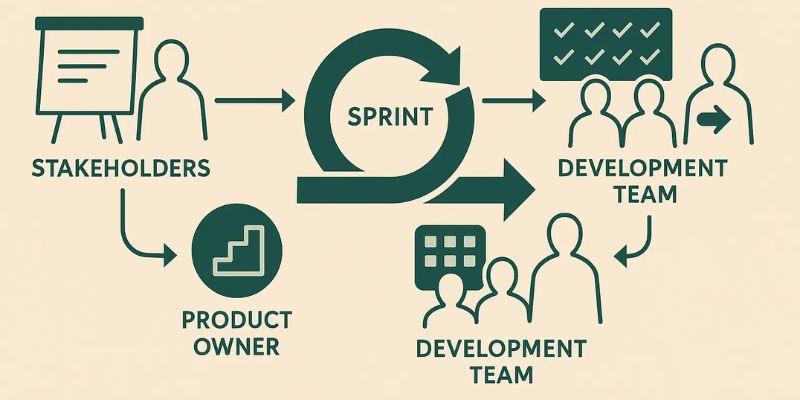
Although modern firms frequently experiment with combining responsibilities to increase efficiency, agile teams thrive on clearly defined roles. Is it possible for a Scrum Master to also be a Product Owner? This is a frequently asked question. It may appear pragmatic at first fewer personnel, quicker decisions, and more efficient communication. But under the Scrum framework, these responsibilities were purposefully created to counterbalance one another.
A detailed examination of duties, team dynamics, and potential trade-offs is necessary to determine whether one person can effectively manage both. This guide explains when it makes sense to combine these roles, when it doesn’t, and how to make the best choice for your Agile team without sacrificing output or quality. FITA Academy offers specialized Scrum Master training programs that help learners master Agile methodologies, team facilitation, sprint planning, and efficient project delivery for real-world applications.
Understanding the Responsibilities of a Scrum Master and Product Owner
You must first comprehend the requirements of each function in order to assess whether one individual can perform both. As a facilitator, a Scrum Master makes sure the team adheres to Agile principles and eliminates roadblocks that impede advancement. They emphasize cooperation, team well-being, and ongoing development. Conversely, the Product Owner is in charge of managing the backlog, creating the product vision, and setting task priorities according to commercial value.
The Product Owner is business-focused, whereas the Scrum Master is team-oriented. While the other makes sure the appropriate product is being built, the first makes sure the process runs smoothly. Different mindsets are needed for these responsibilities one neutral and encouraging, the other resolute and deliberate. It’s crucial to assess whether one individual can genuinely balance both viewpoints because combining them might cause priorities to become hazy if done carelessly.
Differences and Overlaps Between the Two Roles
There are several places where the duties of Scrum Master and Product Owner overlap, notwithstanding their differences. Strong communication abilities, leadership traits, and a thorough comprehension of Agile methodologies are necessary for both positions. Additionally, they work closely together to guarantee that the team produces value effectively. Scrum Master Training in Chennai offers industry-oriented learning that helps professionals gain expertise in Agile methodologies, sprint planning, team facilitation, and project management.
Nonetheless, the distinctions outweigh the similarities. While a Product Owner must make solid decisions regarding priorities, a Scrum Master must maintain objectivity, particularly during conflicts. This fosters a natural tension that keeps teams in balance. One person may find it difficult to remain impartial while simultaneously achieving corporate goals if they take on both responsibilities. However, some overlap may be acceptable in startups or smaller teams. The secret is to identify areas where duties overlap and make sure that merging positions doesn’t affect team dynamics or decision-making.
Situations Where a Scrum Master Can Take on Product Owner Responsibilities
Combining these positions can be successful in certain situations. One person may need to take on many responsibilities due to resource constraints in small businesses or early-stage startups. In certain situations, a Scrum Master with solid business acumen and product insight may temporarily assume the role of Product Owner.
Another situation occurs in times of change, like when a Product Owner departs and no replacement has been hired. To keep things running smoothly and avoid interruptions, a Scrum Master might intervene. Additionally, the Scrum Master may have sufficient bandwidth to oversee backlog priority in highly skilled teams that need little assistance. These circumstances, though, should ideally have temporary fixes. If long-term role combinations are not properly handled, they may result in inefficiencies and disputes.
Potential Challenges and Conflicts of Interest
The conflict of interest that results from merging these jobs is one of the main issues. While the Product Owner frequently uses those pressures to achieve business objectives, the Scrum Master is in charge of shielding the team from outside demands. One person may inadvertently give priority to one duty over the other when they play both responsibilities. B School in Chennai can significantly boost your career readiness and employability by enhancing your Agile knowledge, sprint planning skills, team facilitation techniques, and overall Scrum Master expertise.
For instance, because they are the source of the unreasonable expectations, they may fail to confront them or push the team to achieve more quickly at the price of sustainable practices. Over time, this may result in decreased team morale, burnout, and poorer product quality. Decision bias is another difficulty. While a Scrum Master should maintain objectivity during team discussions, a Product Owner must make difficult decisions about priorities. It can be mentally exhausting to juggle these competing obligations, and it may make you less productive in both professions.
Skills and Qualities Required to Handle Both Roles
If a company chooses to merge these positions, the person must have a certain set of abilities. Effective communication is crucial because one must distinguish between their role as a facilitator and a decision-maker. Since both positions require a lot of attention, time management is equally crucial.
They also require a thorough comprehension of corporate strategy, stakeholder management, and Agile principles. In order to resolve team disputes objectively, emotional intelligence is essential. It’s also essential to be able to swiftly transition from team advocate to product strategist viewpoints. These are the key benefits of scrum technology. Not everyone is able to effectively manage both tasks, even with considerable abilities. Before giving someone dual responsibility, organizations should carefully consider whether they have the necessary skills and expertise.
Real-World Scenarios: When It Works and When It Fails
In reality, there are conflicting outcomes when Scrum Master and Product Owner roles are combined. Because teams are more adaptable and communication is straightforward, it can be successful in tiny firms with less funding. One individual may handle both responsibilities without major disagreement thanks to the decreased complexity.
However, this strategy frequently fails in larger organizations or complicated projects. Priorities may be unclear to teams, and poor decision-making may result from a lack of role separation. When a Scrum Master takes on the role of Product Owner, for example, they may prioritize features without properly accounting for team capability, which can result in missed deadlines and frustration. Clear boundaries, solid experience, and short-term execution are typically necessary for successful situations. Organizations that attempt to make this system permanent without addressing its underlying issues frequently fail.
Best Practices for Organizations Considering This Approach
It’s crucial to take a calculated approach if your company is thinking about merging these positions. Establish limits and clearly define roles first. Even if a single individual has both titles, they should deliberately act and make decisions according to the role they are playing at that particular moment.
To find problems early, the team must provide regular feedback. To determine whether the dual function is impacting team morale or productivity, conduct retrospectives. It’s also beneficial to offer extra assistance, like designating a backup facilitator for Scrum ceremonies or actively engaged stakeholders. Above all, consider this a short-term fix rather than a long-term framework. Shifting to distinct responsibilities can assist preserve equilibrium and guarantee long-term success when the team expands or the project gets more complicated.
What is Next?
Depending on the situation, team size, and organizational requirements, a Scrum Master may or may not be a Product Owner. Although it is feasible in some circumstances, there are important obstacles to overcome. By keeping a balance between process and product priorities, these positions are intended to complement one another. If not handled carefully, combining them can upset that equilibrium.
Businesses should balance the advantages of efficiency against the dangers of conflict and diminished efficacy. Most of the time, better results come from keeping the responsibilities distinct. If combining them is required, nevertheless, it should be done carefully, with defined boundaries and ongoing assessment. The ultimate objective is to provide value and support the team; the structure that best does this is the greatest option.